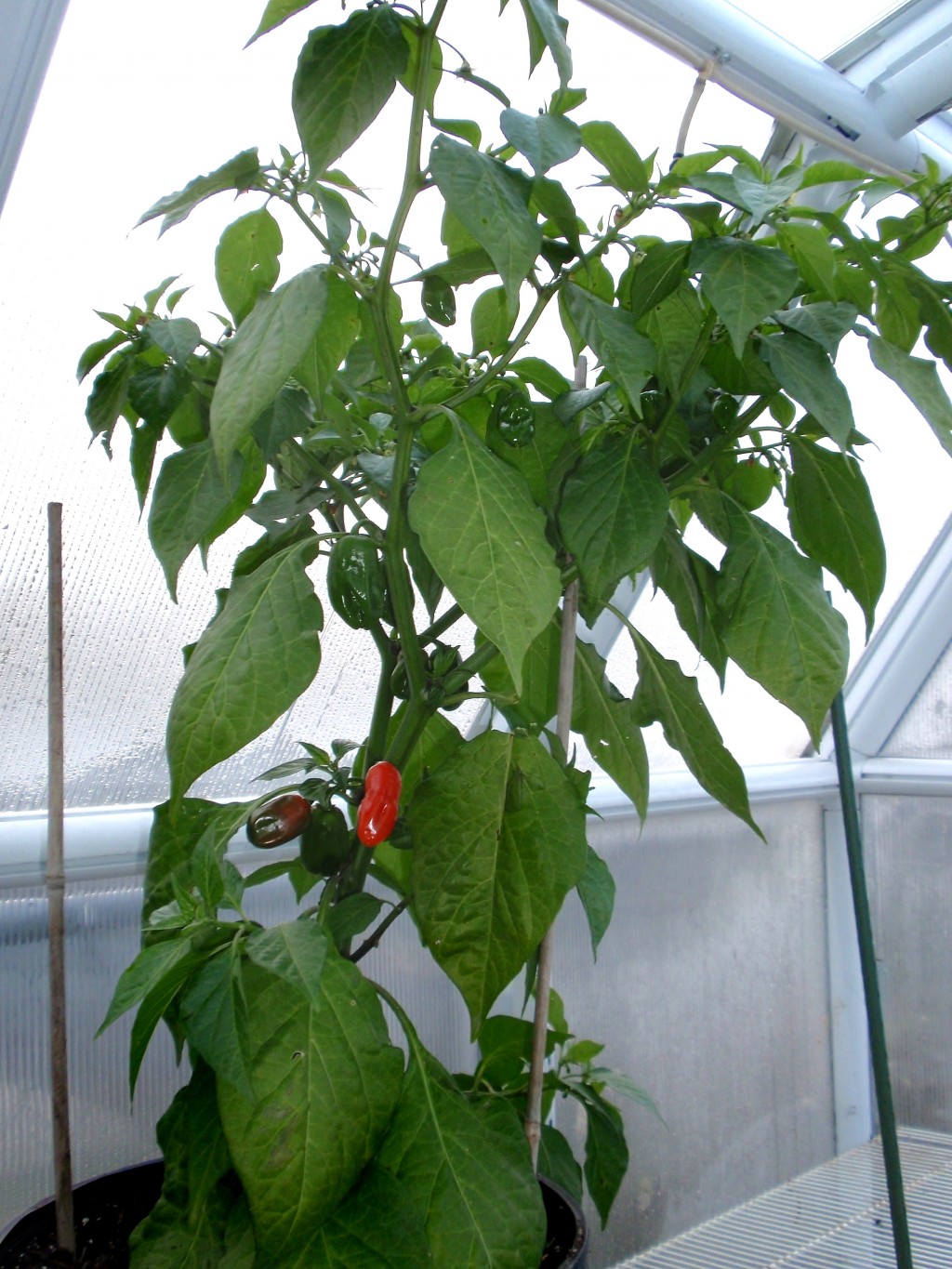
With respect to gardening, other than this blog and a few conversations with neighbors, I stick to myself. But in one of those conversations, I’ve been told that there is a debate raging about how best to quantify the heat of hot peppers. Thinking, the conversation was with Jean Romero-Stevenson, who it turns out is a bit of a pepper head. Though, she’s a sane pepperhead. Nina Winand is an insane pepperhead, having started over 60 varieties last year. You read that right? Not 60 plants, 60 VARIETIES.
But back to the conversation with Jean, and the debate. If I understand the debate, there is one group who thinks Scoville heat can be done by purely quantitative chemical assay. Another, the equivalent of vinyl fans (remember vinyl phonograph records?), the ‘purists’ (not mockingly) who maintain that human taste is quite complex, and that other factors in the pepper affect the sensation of the capsaicin, so Scoville ratings can, should, and will always be better done by humans. Expert tasters if you will.
I’m sure somebody out there cares where I weigh in on this. Well, like my politics, I pick the best from both sides. Let me start by criticizing an article that beat me to LC-GC magazine called “Simple and Fast Quantification of Capsaicinoids in Hot Sauces Using Monolithic Silica Capillaries and LC-MS”, by Simon Forster and Stephan Altmaier. What I did not like about this article, and to be fair, the authors goals were certainly not to quantify peppers, or even the taste of hot sauces, so from the outset my criticism isn’t fair. That said, here it is: what is the real value to pepperheads of quantifying the levels of capsaicinoids in hot sauces? And, double disappointment, I didn’t even see a key to tell which brands corresponded with which results.
So how do we relate Scoville heat, the taste of peppers, the ratios of specific capsaicinoids, hot sauce, and whatever else we pepperheads cherish? We don’t, yet. It’s a complex problem, and though the previous study gives us a hint at what we’re contemplating, certainly half the challenge is to understand what it is we’re setting out to do, and how it should be done in order to accomplish something of value.
My general approach is to be quantitative, but peppers are more than the capsaicinoids. What makes a jalepeno a jalepeno? What makes a habanero so darn worth all that heat? I’m not even going to go near hot sauces. That’s a decade away. What is it about the pepper themselves that works with or against the capsaicinoids to produce the flavor behind the heat? This is a serious question, and to get started, I’ve installed an HPLC system on a cart in my workshop/lab.
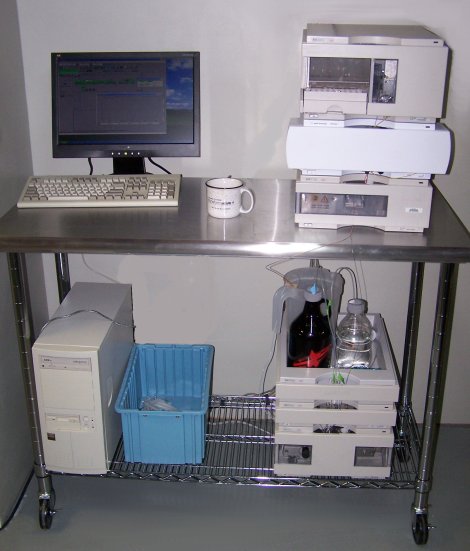
This is it. It’s an Agilent 1100 (last gen, not latest gen) HPLC system. I’ve set it up on wheels, as I’m prone to do, so it’s moveable, and can be easily cleaned around. To do this, I had to place the pump, solvent tray and de-gasser on the bottom shelf, so the whole assembly wouldn’t be top-heavy. To do this, I made up a special 0.007″ ID stainless steel fluidic link 1.3 meters long. So instead of the traditional (top heavy) arrangement with the pump on top, I pump the solvents up to the sample handler on the top of the ‘stack’ on the top shelf. From there, the fluid path proceeds as normal, down through the column heater unit and finally to the detector, which is at the bottom of the stack on the top shelf. This is a really handy arrangement. Note the ‘data system’ (the computer) sits handily to the left, is generally away from solvents, and there’s still enough bench space for odds and ends.
So, what’s next? System qualification. Then, initial method development. Standards development. exploring, poking around, and with luck, this fall, when the peppers are harvested, I’ll have a very basic method which will probably not even separate the various capsaicinoids, but with some luck will separate some of the flavor elements of the peppers. Babe in the woods? Yea, I know. Real chromatographers are laughing their a$$es off.
But so what. It’s not what you don’t yet know that’s important, it’s what you’re learning. The body of knowledge in this big crazy world is probably not even imaginable by any individual in it. I’m not sure if that’s happened yet, or if we’re close, but for a big chunk of very recent history I suspect it may have been possible for the very best of the Renaissance men (Jefferson, Franklin, and their like) to know a darn big chunk of available theoretical human knowledge. Say what? 5%? even 0.5%? That’s a big percent of the available theoretical knowledge at the time. The knowledge of how stuff works. Today, it’s not possible to be as broadly educated as our predecessors. But don’t let that stop you.
My cousin inherited a book from my Grandfather Best, which was a compliment to the ‘Poor Richards Encyclopedia’ set. This book was about 4 inches thick, printed on bible paper. It was said to contain a vast amount of knowledge, and sold to farmers so they might have at least all the practical knowledge they might need living fairly independently on the rural farmstead of the late 18th century. I hope that books still around somewhere, because I would surely love to thumb through it. I wonder what indirect references there were, pre-echos, to what we can know today. It’s a great time to be alive.










































 John's Garden Journal


